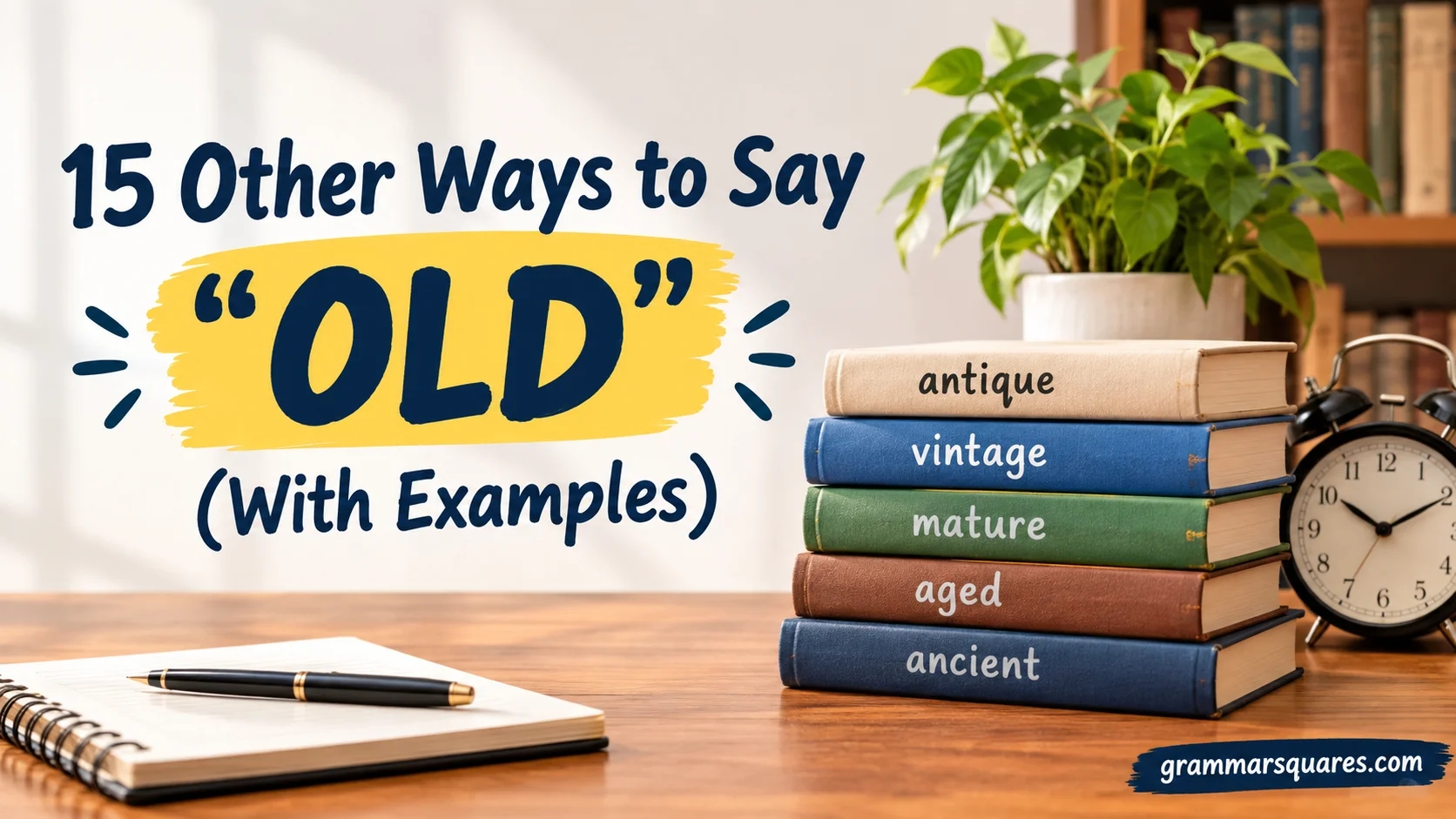
When you need to describe someone or something, 15 Other Ways to Say “OLD” (With Examples) helps you choose respectful and natural alternatives for different situations. The word old is useful, but describing a person can feel delicate, especially in speaking and writing. Calling someone old may sound blunt or impersonal, while thoughtful language lets you express respect, affection, nostalgia, and admiration. For example, a beloved grandparent may be aged or elderly, while an antique chair may be vintage or ancient. A centuries-old tradition can also sound more meaningful when you choose a specific, descriptive, and respectful alternative.
In my experience, choosing the right word depends heavily on the age, time, and feeling you want to convey. The best alternatives depend on the situation and the object. Outdated suits something from an earlier period that is no longer suitable, while mature, aged, ancient, vintage, and elderly have different meanings, tones, and usage notes.
When choosing an alternative, consider whether your sentence needs a formal, natural, warmer, or more precise expression. This guide provides clear definitions and realistic examples to help you explore useful synonyms and make your message more personal and interesting. A simile can also add depth when discussing cherished memories or familiar things, while easy examples make your writing clearer without sounding dismissive.
What Does “OLD” Mean?
Old generally describes someone or something that has existed for a long period of time. When referring to a person, it can indicate that someone has lived for many years, although the word can sound blunt depending on the context. For objects, old usually means something has been used or existed for a long time, such as an old house, old book, or old car. The word can also refer to something from an earlier period, as in “my old job,” where it means a former job rather than something aged. In other contexts, old can suggest that something is outdated, familiar, traditional, worn, or no longer current.
Common Situations Where “OLD” Is Used
People use old in everyday conversation, text messages, social media, personal communication, school, work, and writing. It can describe people, buildings, objects, traditions, relationships, ideas, documents, memories, and previous situations.
The context matters greatly. Saying “an old friend” usually means someone you have known for a long time, while “an old computer” may mean a computer that is no longer modern. “An old building” could simply mean a building constructed many years ago, whereas “an old system” might suggest that the system is outdated.
Because old has several meanings, choosing a more precise alternative can prevent confusion. A writer might use vintage to emphasize style, ancient to emphasize great age, former to mean something from the past, or outdated to indicate that something is no longer current.
Is It Professional or Polite to Say “OLD”?
Old is a normal and widely understood English word, but its tone depends strongly on what it describes. It is usually neutral and casual when referring to objects, places, traditions, or things from an earlier period. For example, “an old document” is perfectly ordinary.
When talking about people, however, old can sometimes sound too direct. In respectful or professional communication, alternatives such as elderly, older, or a more specific description may be more appropriate depending on the context. In other situations, words such as seasoned or mature can focus on experience rather than age.
The key is to consider context, relationship, and intended meaning rather than assuming one alternative always sounds better.
Advantages and Disadvantages of Saying “OLD”
Advantages
The main advantage of old is its simplicity and flexibility. Almost everyone understands it immediately, and it can describe age, history, familiarity, or a previous situation. It also works naturally in everyday phrases such as “old friend,” “old house,” “old photo,” and “old-fashioned.”
Disadvantages
Its biggest limitation is that it can be too broad. The word does not always tell readers whether something is historic, outdated, worn, traditional, previous, or simply familiar. When describing a person, it can also sound blunt or insensitive in certain contexts. A more precise alternative can communicate the intended meaning more clearly and respectfully.
Synonyms for “OLD”
- Aged
- Elderly
- Ancient
- Antique
- Vintage
- Dated
- Outdated
- Former
- Previous
- Long-standing
- Well-worn
- Timeworn
- Mature
- Seasoned
- Traditional
1. Aged
Meaning
Aged describes someone or something that has reached an advanced age or has existed for a considerable period. It can sound more descriptive than simply saying old.
Definition
Aged means having lived, existed, or developed over a long period of time.
Detailed Explanation
“Aged” often emphasizes length of existence rather than simply saying that something is old. It is particularly natural for certain objects, materials, food, and beverages, such as aged wood or aged cheese. When used for people, it can sound formal or somewhat clinical, so context matters. It can also suggest that age has produced a particular quality or character.
Scenario Examples
Scenario: Describing a traditional wooden structure.
Example: “The cabin was built from aged timber that had developed a beautiful character.”
Scenario: Discussing a food product.
Example: “The restaurant serves an aged cheese with a rich, sharp flavor.”
Scenario: Describing a person’s appearance in a literary context.
Example: “The portrait showed an aged man with a thoughtful expression.”
Best Use
Best for formal descriptions, materials, food, beverages, historical writing, and literary contexts. For everyday conversation about people, “older” is often more natural.
Tone
Tone: Descriptive, formal, sometimes literary.
It emphasizes the passage of time without always carrying the negative suggestion of being outdated.
2. Elderly
Meaning
Elderly specifically refers to a person who is older in age, usually someone in later life.
Definition
Elderly means relatively advanced in age, particularly when describing an older person.
Detailed Explanation
Unlike old, elderly is used specifically for people rather than objects. It can sound more respectful and descriptive in some contexts, particularly when discussing services, healthcare, accessibility, or demographics. However, some people consider the word too broad or impersonal, so “older person” may be preferable in everyday communication. The appropriate choice depends on the context and the individual.
Scenario Examples
Scenario: Describing a person who needs assistance in a public place.
Example: “A staff member helped an elderly passenger find a seat.”
Scenario: Discussing community services.
Example: “The center offers transportation for elderly residents.”
Best Use
Best for formal, informational, medical, social-service, and demographic contexts when discussing older people.
Tone
Tone: Formal, respectful, somewhat institutional.
It is more specific than “old,” but “older” can sound more neutral and conversational.
3. Ancient
Meaning
Ancient describes something that is extremely old, especially something connected with a distant historical period.
Definition
Ancient means belonging to or dating from a very long time ago.
Detailed Explanation
“Ancient” is much stronger than ordinary old. It suggests a great distance in time and is commonly associated with civilizations, artifacts, ruins, traditions, languages, and historical periods. It is not normally used simply to describe something that is a few decades old. In casual speech, people may also use it humorously to exaggerate how old something feels.
Scenario Examples
Scenario: Discussing a historical site.
Example: “The archaeologists discovered an ancient temple beneath the hillside.”
Scenario: Talking humorously about an outdated device.
Example: “My laptop feels ancient compared with the new models.”
Best Use
Best for history, archaeology, literature, historical objects, and playful exaggeration.
Tone
Tone: Historical, dramatic, descriptive.
It conveys a much greater sense of age than the ordinary word “old.”
4. Antique
Meaning
Antique describes an old object, especially one valued because of its age, craftsmanship, rarity, or historical character.
Definition
Antique means an old collectible object that has particular historical, artistic, or cultural value.
Detailed Explanation
“Antique” is not simply a replacement for every use of old. It is generally used for objects, particularly furniture, jewelry, artwork, books, clocks, and decorative pieces. The word often carries a sense of historical or collectible value. Calling something antique can therefore say more about its character and significance than merely saying it is old.
Scenario Examples
Scenario: Shopping for furniture.
Example: “They found an antique table at a local estate sale.”
Scenario: Describing a family possession.
Example: “This antique clock has been in our family for generations.”
Best Use
Best for collectibles, furniture, artwork, jewelry, decorative objects, and historical possessions.
Tone
Tone: Elegant, appreciative, historical.
It often suggests that age is part of an object’s value rather than a flaw.
5. Vintage
Meaning
Vintage describes something from an earlier period that is valued for its style, quality, character, or distinctive appeal.
Definition
Vintage means characteristic of or originating from an earlier period, especially when that period gives something a desirable style or identity.
Detailed Explanation
“Vintage” differs from old because it often carries a positive or fashionable association. It is frequently used for clothing, cars, furniture, photographs, music, and design. Unlike “antique,” which strongly emphasizes age and historical status, vintage often emphasizes the distinctive character of a particular period. It can also be used loosely in everyday language for things that have a retro feel.
Scenario Examples
Scenario: Talking about clothing.
Example: “She wore a vintage jacket from the 1970s.”
Scenario: Describing a car.
Example: “He collects vintage cars and enjoys restoring them.”
Scenario: Discussing home decoration.
Example: “The café has a vintage style with wooden furniture and old posters.”
Best Use
Best for fashion, cars, furniture, design, music, photography, and nostalgic styles.
Tone
Tone: Stylish, nostalgic, positive.
It often turns the idea of age into a feature rather than a limitation.
6. Dated
Meaning
Dated describes something that feels old-fashioned or no longer suited to current standards, styles, or expectations.
Definition
Dated means no longer modern or fashionable because it reflects an earlier period.
Detailed Explanation
“Dated” focuses less on how many years something has existed and more on how old-fashioned it appears now. A building can be old without looking dated, while a relatively recent design can already look dated. The word is especially useful when discussing fashion, design, technology, writing, or ideas. It can carry a mildly critical tone.
Scenario Examples
Scenario: Reviewing a website design.
Example: “The website looks dated and could benefit from a cleaner layout.”
Scenario: Discussing clothing.
Example: “That particular style feels a little dated now.”
Best Use
Best for design, fashion, technology, writing, advertising, websites, and ideas that no longer feel modern.
Tone
Tone: Neutral to mildly critical.
It suggests that something belongs to an earlier style or standard.
7. Outdated
Meaning
Outdated means something is no longer current, useful, accurate, or appropriate because newer information, methods, or technology has replaced it.
Definition
Outdated means no longer suitable because it is based on an older method, standard, or understanding.
Detailed Explanation
“Outdated” is more specific than old when the issue is usefulness or relevance rather than age alone. An old book can still be valuable, while an outdated manual may contain instructions that are no longer appropriate. The word is especially common in professional, technical, academic, and workplace communication. It can imply that an update or replacement is needed.
Scenario Examples
Scenario: Discussing workplace software.
Example: “The company is replacing its outdated software with a newer system.”
Scenario: Reviewing information online.
Example: “Some of the statistics on that page are outdated.”
Scenario: Discussing a procedure.
Example: “That process is outdated and takes much longer than necessary.”
Best Use
Best for technology, information, systems, procedures, policies, methods, and professional communication.
Tone
Tone: Professional, direct, practical.
It focuses on lack of current relevance, not simply age.
8. Former
Meaning
Former means something or someone that held a particular position, role, relationship, or status in the past but no longer does.
Definition
Former means previous or belonging to an earlier period.
Detailed Explanation
“Former” is one of the most important alternatives when old means “previous” rather than “aged.” For example, an “old boss” may mean a boss from a previous job, but “former boss” makes that meaning clearer. It does not describe physical age. This makes it a useful choice in professional and formal communication.
Scenario Examples
Scenario: Talking about a previous employer.
Example: “I still keep in touch with my former manager.”
Scenario: Discussing a previous position.
Example: “The former director now runs a private consulting firm.”
Best Use
Best for professional communication, biographies, news writing, formal writing, and references to previous roles or relationships.
Tone
Tone: Neutral, professional, precise.
It clearly communicates that something belonged to the past without suggesting that it is physically old.
9. Previous
Meaning
Previous refers to something that came before the current one in time, sequence, position, or experience.
Definition
Previous means existing, occurring, or happening before something else.
Detailed Explanation
“Previous” is useful when old refers to an earlier item or event rather than age. It is particularly common in formal and professional writing because it is precise and neutral. Unlike “former,” it can apply broadly to documents, versions, meetings, examples, experiences, and situations. It usually sounds less personal and more factual.
Scenario Examples
Scenario: Referring to an earlier document.
Example: “Please compare the current report with the previous version.”
Scenario: Talking about an earlier meeting.
Example: “We discussed the same issue during our previous meeting.”
Scenario: Discussing a past experience.
Example: “My previous experience in customer service helped me in this role.”
Best Use
Best for work emails, school assignments, reports, instructions, documents, and formal communication.
Tone
Tone: Neutral, professional, precise.
It works especially well when you want to emphasize sequence rather than age.
10. Long-standing
Meaning
Long-standing describes something that has existed or continued for a long period, often with an emphasis on stability or continuity.
Definition
Long-standing means existing, established, or continuing for many years.
Detailed Explanation
“Long-standing” is especially useful when the fact that something has lasted a long time is important or meaningful. It can describe relationships, traditions, agreements, problems, partnerships, and institutions. Unlike “old,” it often has a more positive or formal sense of continuity. It does not necessarily suggest that something is outdated.
Scenario Examples
Scenario: Discussing a business relationship.
Example: “The two companies have a long-standing partnership.”
Scenario: Talking about a friendship.
Example: “She is a long-standing friend of the family.”
Scenario: Describing an unresolved issue.
Example: “The committee is working to address a long-standing problem.”
Best Use
Best for professional communication, relationships, institutions, traditions, agreements, and persistent situations.
Tone
Tone: Professional, respectful, established.
It highlights continuity and duration rather than simply age.
11. Well-worn
Meaning
Well-worn describes something that has been used frequently for a long time, often showing visible signs of use.
Definition
Well-worn means heavily or repeatedly used over time.
Detailed Explanation
“Well-worn” is more specific than old because it suggests that repeated use has left visible or recognizable signs. It commonly describes shoes, clothing, books, furniture, paths, and objects. It can also be used figuratively for familiar ideas or expressions, such as a well-worn argument. Depending on context, it can sound either warmly nostalgic or mildly critical.
Scenario Examples
Scenario: Describing a favorite book.
Example: “Her well-worn novel had notes and folded pages throughout.”
Scenario: Talking about shoes.
Example: “He put on his well-worn boots before heading outside.”
Scenario: Discussing a familiar argument.
Example: “The article relies on a well-worn argument that readers have heard before.”
Best Use
Best for physical objects that show use, as well as familiar ideas or arguments in descriptive writing.
Tone
Tone: Descriptive, nostalgic, sometimes critical.
It emphasizes use and familiarity, not simply age.
12. Timeworn
Meaning
Timeworn describes something that has become worn, familiar, or weakened through long passage of time or repeated use.
Definition
Timeworn means affected by age or repeated use, or overly familiar because it has been repeated many times.
Detailed Explanation
“Timeworn” has a more literary and expressive quality than “old.” It can describe physical objects that have been affected by time, such as timeworn buildings or surfaces. It can also describe ideas, clichés, explanations, and traditions that have been repeated so often that they no longer feel fresh. The exact meaning depends on what follows the word.
Scenario Examples
Scenario: Describing an old building.
Example: “The village was filled with timeworn stone houses.”
Scenario: Critiquing an argument.
Example: “The speech repeated several timeworn clichés.”
Best Use
Best for creative writing, descriptive prose, literature, architecture, traditions, clichés, and familiar ideas.
Tone
Tone: Literary, descriptive, reflective.
It gives age a stronger sense of history and accumulated experience.
13. Mature
Meaning
Mature can describe a person, organization, idea, product, or system that has developed over time and reached a more advanced or established stage.
Definition
Mature means fully developed, experienced, or established.
Detailed Explanation
“Mature” is not a direct substitute for every meaning of old. It is useful when age is connected with development, experience, stability, or completeness. Calling someone mature usually focuses on behavior or judgment rather than chronological age. Similarly, a mature company may be well-established rather than simply old.
Scenario Examples
Scenario: Describing someone’s approach to a disagreement.
Example: “She handled the difficult conversation in a mature way.”
Scenario: Discussing a business.
Example: “The company has become a mature business with established processes.”
Scenario: Describing an idea.
Example: “The project is now at a mature stage of development.”
Best Use
Best for people, organizations, projects, ideas, markets, products, and development stages.
Tone
Tone: Positive, respectful, professional.
It emphasizes growth, experience, and development rather than simply age.
14. Seasoned
Meaning
Seasoned describes someone who has gained considerable experience through time and practice.
Definition
Seasoned means experienced, practiced, and knowledgeable as a result of doing something for a long time.
Detailed Explanation
“Seasoned” is particularly useful when the important quality is experience rather than age. It is common in professional settings and can describe workers, leaders, journalists, performers, athletes, and other people with substantial experience. Unlike “old,” it generally has a positive implication. It should not be used when you simply want to state someone’s chronological age.
Scenario Examples
Scenario: Discussing a professional colleague.
Example: “We hired a seasoned manager to lead the new department.”
Scenario: Describing a journalist.
Example: “The event was covered by a seasoned reporter with decades of experience.”
Scenario: Talking about a performer.
Example: “She is a seasoned performer who knows how to handle a large audience.”
Best Use
Best for professional communication, leadership, careers, journalism, business, sports, and other experience-based contexts.
Tone
Tone: Positive, respectful, professional.
It highlights skill and experience, making it very different from simply calling someone “old.”
15. Traditional
Meaning
Traditional describes something that follows long-established customs, methods, styles, or beliefs.
Definition
Traditional means based on practices, ideas, or styles that have been passed down or maintained over time.
Detailed Explanation
“Traditional” does not necessarily mean physically old. Instead, it focuses on the fact that something follows an established way of doing things. A traditional recipe may be prepared today using a method that has existed for generations. The word is especially useful when discussing culture, food, clothing, ceremonies, architecture, and social practices. It can therefore communicate continuity without implying that something is outdated.
Scenario Examples
Scenario: Discussing food.
Example: “The restaurant specializes in traditional recipes from the region.”
Scenario: Talking about a cultural celebration.
Example: “The ceremony includes several traditional customs.”
Scenario: Describing clothing.
Example: “Guests were encouraged to wear traditional clothing for the celebration.”
Best Use
Best for culture, food, ceremonies, clothing, customs, architecture, and established practices.
Tone
Tone: Respectful, cultural, descriptive.
It emphasizes heritage and continuity, rather than age alone.
FAQs
What is another way to say “OLD”?
Another way to say old depends on what you mean. Aged can emphasize age, ancient suggests great historical age, vintage often suggests nostalgic style, outdated means no longer current, and former means something from the past. The best alternative depends on the context.
What does “OLD” mean?
Old generally means having existed for a long time. It can describe age, but it can also mean former, familiar, outdated, or traditional, depending on the sentence. For example, “old friend” usually refers to a long-standing friendship rather than a friend who is elderly.
Is “OLD” professional?
Old is a normal English word and can be professional when the context is appropriate. For example, “old records” or “old documents” can sound perfectly neutral. When referring to people, however, a more specific expression such as older, elderly, or seasoned may communicate the intended meaning more appropriately.
What is a more polite way to say “OLD”?
When referring to a person, older is often a neutral alternative, while elderly can work in formal or informational contexts. If the intended meaning is experience rather than age, seasoned may be more appropriate. The most respectful choice depends on what you actually want to communicate.
Which alternative works best in formal communication?
There is no single alternative that works in every formal situation. Previous and former are useful when referring to something from the past, outdated works when something is no longer current, and long-standing is appropriate when emphasizing continuity. Choosing the word that matches the exact meaning is more important than simply replacing “old.”
Conclusion
The word old is useful because it is simple and flexible, but its broad meaning can sometimes leave room for confusion. The best alternative depends on what you actually want to express. Vintage can highlight style and nostalgia, ancient emphasizes great age, outdated focuses on something no longer being current, while former and previous clearly refer to the past. Words such as seasoned, mature, and long-standing shift attention toward experience, development, or continuity.
When choosing another way to say old, consider the meaning, tone, audience, and context first. A precise word does more than make your vocabulary varied—it helps your reader understand exactly what you mean.
