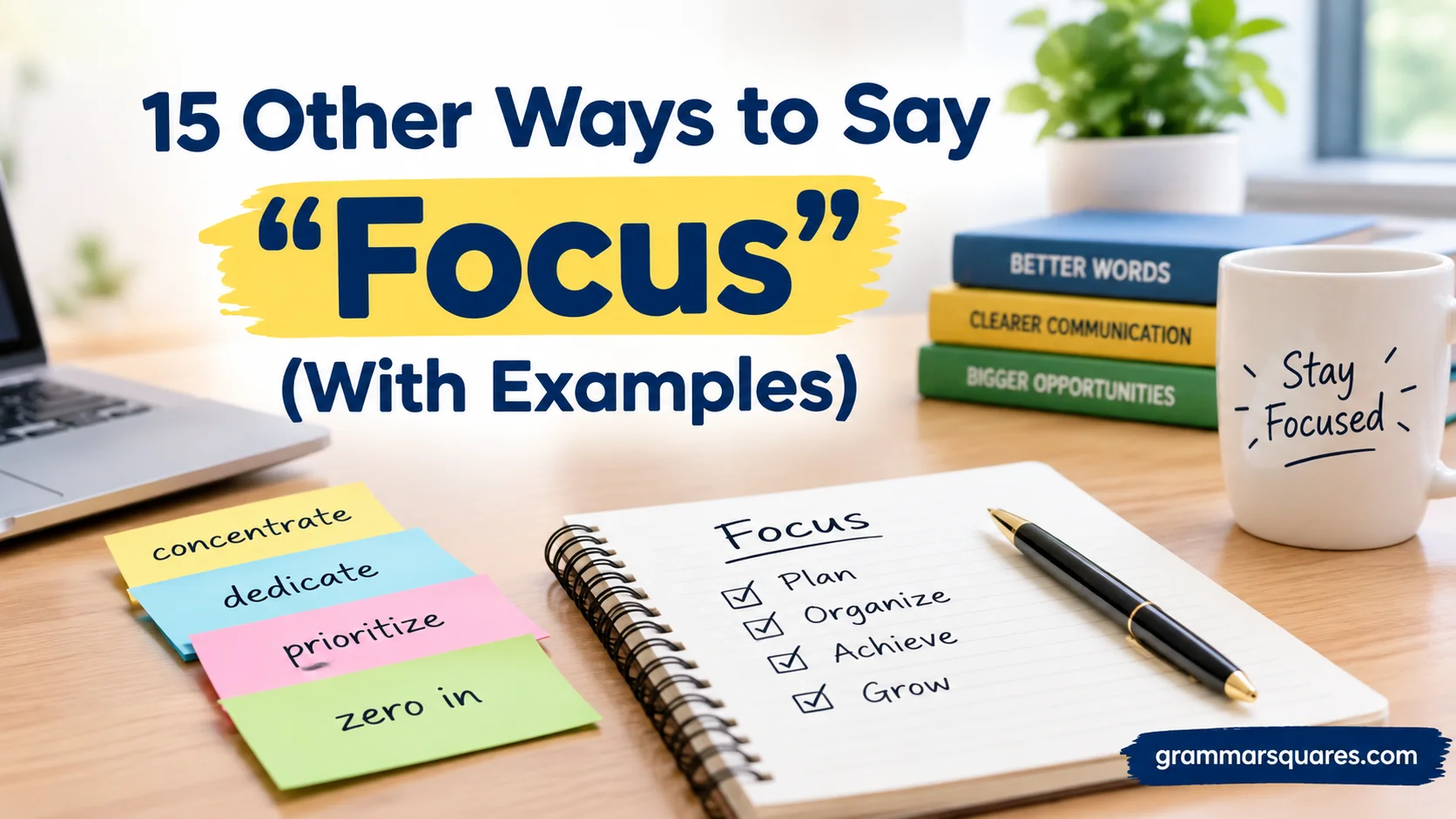
This guide to 15 Other Ways to Say “Focus” (With Examples) shows how clear words can shape attention, meaning, tone, and everyday communication. When you think about Focus, you may picture camera lenses finding a point where the subject is clear and in focus. The same word can describe paying attention, concentrating, or giving energy to one thing. Sleepy students need concentration while learning, while a camera uses a lens to keep its subject sharp. In Latin, the origin of focus meant domestic hearth, a centre of the home, and kitchens can still be the centre of a modern home.
The word can function as a verb or noun, with its meaning shaped by context. In communication, choosing a familiar word or an alternative depends on the exact idea and tone you want to express. You may focus on work, a task, an activity, an essay, or a particular goal, instead of stopping to play video games or leaving your writing and content all over the place.
Attention, emphasis, direction, priority, clarity, and specificity can each give an expression a clearer, more natural, and professional sound. A writer might choose a specific term when highlighting an issue or directing your effort toward a goal. These practical alternatives, meanings, examples, and guidance can help you write better sentences, speak with greater variety, and communicate correctly in different situations. This article will explore 15 focus synonyms and their practical uses.
What Does “Focus” Mean?
“Focus” generally means giving your attention, effort, or energy to something specific. As a verb, it can mean concentrating on a task or directing attention toward an issue, such as “I need to focus on my work.” As a noun, it can describe the main subject, purpose, or area of attention, as in “Customer service is our main focus.” The word can therefore communicate concentration, priority, attention, or central importance depending on the context.
Common Situations Where “Focus” Is Used
People use “focus” in everyday conversation, education, work, personal communication, and formal writing. You might tell a friend to focus on an exam, ask a coworker to focus on a particular project, or explain that a meeting will focus on customer concerns. It also appears frequently in business plans, academic writing, presentations, emails, and social media.
Because “focus” covers several related ideas, an alternative can sometimes make your meaning more precise. For example, “concentrate on” emphasizes mental attention, while “prioritize” suggests deciding what deserves attention first. Choosing the right wording helps readers understand exactly what you mean.
Is It Professional or Polite to Say “Focus”?
Yes. “Focus” is generally neutral, professional, and widely acceptable. It works naturally in workplace emails, academic writing, presentations, instructions, and everyday speech. However, phrases such as “focus on this now” can sound direct or commanding when used as an instruction.
In a sensitive conversation, a softer expression may feel more collaborative. In formal writing, alternatives such as “concentrate on,” “emphasize,” or “prioritize” may be more precise depending on the intended meaning.
Advantages and Disadvantages of Saying “Focus”
Advantages
“Focus” is short, familiar, and versatile. It works as both a noun and a verb, so you can use it in many situations without sounding unusual. It also communicates the basic idea of directing attention or effort clearly, making it useful in professional and casual communication.
Disadvantages
The main limitation is that “focus” can sometimes be too broad. It may not tell the reader whether you mean concentration, priority, emphasis, or simply the main subject. Repeating it frequently can also make writing feel predictable. A more specific expression can add precision and variety when the context calls for it.
Synonyms for “Focus”
- Concentrate on
- Pay attention to
- Zero in on
- Center on
- Give priority to
- Prioritize
- Direct your attention to
- Keep your mind on
- Devote attention to
- Hone in on
- Emphasize
- Spotlight
- Key in on
- Concentrate your efforts on
- Make a priority of
1. Concentrate on
Meaning
Concentrate on means giving your mental attention and effort to one particular thing. It is one of the closest alternatives to the verb “focus,” especially when talking about mental concentration.
Definition
Concentrate on: To give your full attention or mental effort to something.
Detailed Explanation
“Concentrate on” is especially useful when someone needs to avoid distractions and give sustained attention to a task. It sounds slightly more explicit than “focus” because it emphasizes mental effort and attention. It works well in education, work, and everyday conversation. Unlike some alternatives, it usually suggests active mental concentration rather than simply identifying a priority.
Scenario Examples
Scenario: A student is preparing for an important exam.
Example: “I need to concentrate on my chemistry notes tonight.”
Scenario: A manager wants the team to address one issue first.
Example: “Let’s concentrate on fixing the customer complaints before starting another project.”
Scenario: You are trying to work without distractions.
Example: “I can’t concentrate on anything with all this noise.”
Best Use
Best for studying, working, problem-solving, and situations involving mental attention.
Tone: Clear, neutral, practical. It sounds natural in both casual and professional communication.
2. Pay attention to
Meaning
Pay attention to means deliberately noticing or listening carefully to something. It is related to “focus,” but it puts more emphasis on awareness and careful observation.
Definition
Pay attention to: To notice, listen to, or carefully observe something.
Detailed Explanation
This expression is useful when you want someone to notice a detail, instruction, person, or situation. It can be more conversational than “focus.” It does not always imply long-term concentration; sometimes it simply means notice this carefully right now. Because of that, it is especially natural in instructions and everyday conversation.
Scenario Examples
Scenario: A teacher is explaining an important instruction.
Example: “Please pay attention to the final question on the worksheet.”
Scenario: A friend notices that you are ignoring an important detail.
Example: “You should pay attention to what she’s actually saying.”
Scenario: A customer needs to check product instructions.
Example: “Please pay attention to the safety information before using the product.”
Best Use
Best for instructions, conversations, teaching, warnings, and everyday situations.
Tone: Friendly, direct, and sometimes instructional. It can sound firm depending on how it is delivered.
3. Zero in on
Meaning
Zero in on means directing close attention toward a particular person, problem, detail, or target. It suggests becoming very specific and deliberate.
Definition
Zero in on: To concentrate closely on a particular target, issue, or detail.
Detailed Explanation
This expression is more specific than the general word “focus.” It suggests narrowing your attention until you identify the exact thing that matters. It is common in journalism, business discussions, investigations, and everyday speech. Because it is an idiomatic expression, it sounds more conversational than highly formal.
Scenario Examples
Scenario: A team is trying to identify why sales declined.
Example: “We need to zero in on the reason customers stopped returning.”
Scenario: A journalist investigates one important detail.
Example: “The report zeroed in on the company’s unusual spending patterns.”
Scenario: You are troubleshooting a technical problem.
Example: “Let’s zero in on the error message first.”
Best Use
Best for problem-solving, investigation, analysis, journalism, and informal professional conversation.
Tone: Direct, energetic, and conversational.
4. Center on
Meaning
Center on means having something as the main subject, theme, or point of attention. It is often used when describing what a discussion, story, project, or activity is mainly about.
Definition
Center on: To have something as the main subject or central concern.
Detailed Explanation
“Center on” is useful when you are describing the central idea of something rather than someone’s mental concentration. For example, a meeting can center on customer feedback, or a novel can center on family relationships. It therefore overlaps with “focus” as a noun or verb but often sounds more structural or thematic.
Scenario Examples
Scenario: A meeting has one main subject.
Example: “Tomorrow’s discussion will center on employee training.”
Scenario: You are describing a novel.
Example: “The story centers on a young woman rebuilding her life.”
Scenario: A community event has a particular theme.
Example: “This year’s campaign centers on environmental awareness.”
Best Use
Best for meetings, stories, projects, discussions, campaigns, and academic writing.
Tone: Neutral, polished, and slightly formal.
5. Give priority to
Meaning
Give priority to means deciding that something deserves more attention or importance than other things.
Definition
Give priority to: To treat something as more important or urgent than other matters.
Detailed Explanation
This expression is not simply about concentration. It emphasizes importance and order of attention. You might focus on several things while giving priority to one of them first. It is therefore especially useful when discussing responsibilities, deadlines, resources, or competing tasks.
Scenario Examples
Scenario: A manager must decide which project comes first.
Example: “We should give priority to the projects with the closest deadlines.”
Scenario: A student has several subjects to study.
Example: “I’m going to give priority to the topics I find most difficult.”
Scenario: A company is improving customer service.
Example: “We need to give priority to urgent customer requests.”
Best Use
Best for workplace communication, planning, management, scheduling, and formal writing.
Tone: Professional, organized, and purposeful.
6. Prioritize
Meaning
Prioritize means deciding what should receive attention, time, effort, or resources first or most strongly.
Definition
Prioritize: To arrange tasks, needs, or goals according to their importance or urgency.
Detailed Explanation
“Prioritize” is a strong choice when “focus” really means choosing what matters most. It suggests making a decision about competing demands rather than simply concentrating. The word is especially common in workplace, business, academic, and productivity contexts. It can sound more decisive than “focus on.”
Scenario Examples
Scenario: You have several deadlines approaching.
Example: “I need to prioritize the report because it’s due tomorrow.”
Scenario: A business is managing limited resources.
Example: “The team must prioritize essential maintenance this month.”
Scenario: You are planning your personal goals.
Example: “I’m trying to prioritize sleep and regular exercise.”
Best Use
Best for planning, business, productivity, management, and decision-making.
Tone: Professional, decisive, and practical.
7. Direct your attention to
Meaning
Direct your attention to means deliberately turning your attention toward a particular subject, detail, or issue.
Definition
Direct your attention to: To deliberately make something the subject of your attention.
Detailed Explanation
This expression sounds more formal and deliberate than the simple word “focus.” It works particularly well when guiding an audience toward something important. It is common in presentations, instructions, formal announcements, and professional communication. In casual conversation, it can sound slightly formal.
Scenario Examples
Scenario: A presenter wants the audience to notice a chart.
Example: “Please direct your attention to the graph on the screen.”
Scenario: A teacher introduces an important section.
Example: “Now, direct your attention to the second paragraph.”
Scenario: A formal notice highlights an important issue.
Example: “We ask residents to direct their attention to the updated guidelines.”
Best Use
Best for presentations, formal instructions, speeches, notices, and professional settings.
Tone: Formal, respectful, and instructional.
8. Keep your mind on
Meaning
Keep your mind on means continuing to think about or concentrate on something instead of becoming distracted.
Definition
Keep your mind on: To continue giving mental attention to a particular task or subject.
Detailed Explanation
This phrase has a more conversational and personal feel than “focus.” It is useful when encouraging someone to stay mentally engaged with a task. The expression often suggests avoiding distractions or maintaining attention over time. It sounds natural in everyday speech but is less suitable for formal writing.
Scenario Examples
Scenario: A friend is studying for an exam.
Example: “Try to keep your mind on the assignment for another hour.”
Scenario: Someone is distracted while working.
Example: “I’m having trouble keeping my mind on the task today.”
Scenario: A coach encourages an athlete.
Example: “Stay calm and keep your mind on the next play.”
Best Use
Best for casual conversation, encouragement, personal messages, and everyday situations.
Tone: Casual, supportive, and conversational.
9. Devote attention to
Meaning
Devote attention to means giving something a significant amount of time, care, or mental effort.
Definition
Devote attention to: To intentionally give substantial attention or effort to something.
Detailed Explanation
This phrase suggests a deeper level of commitment than ordinary “focus.” It can imply that someone is deliberately setting aside time or energy for a particular matter. It works well when describing serious work, research, relationships, or responsibilities. The expression is more formal and thoughtful than everyday alternatives such as “pay attention to.”
Scenario Examples
Scenario: A researcher studies a specific topic.
Example: “The study devotes attention to the challenges faced by rural communities.”
Scenario: A manager wants to improve staff development.
Example: “We should devote more attention to employee training.”
Scenario: Someone wants to improve a personal relationship.
Example: “I’ve decided to devote more attention to the people who matter to me.”
Best Use
Best for formal writing, research, professional communication, serious discussions, and personal reflection.
Tone: Thoughtful, deliberate, and somewhat formal.
10. Hone in on
Meaning
Hone in on is commonly used to mean directing close attention toward a specific target, issue, or detail.
Definition
Hone in on: To focus closely on a particular target or subject.
Detailed Explanation
In modern informal and professional English, “hone in on” is widely used to mean narrow your attention toward something specific. It is especially useful when a discussion or investigation becomes more precise. Because usage can vary and “home in on” is also an established expression, writers who want the safest formal wording may prefer “zero in on” or “concentrate on.”
Scenario Examples
Scenario: A marketing team studies one customer group.
Example: “The campaign honed in on younger buyers.”
Scenario: A mechanic investigates a vehicle problem.
Example: “The technician honed in on the source of the strange noise.”
Scenario: A discussion becomes more specific.
Example: “After reviewing the evidence, we honed in on the main issue.”
Best Use
Best for informal professional communication, analysis, discussion, and everyday speech.
Tone: Conversational, focused, and energetic.
11. Emphasize
Meaning
Emphasize means giving something special importance, attention, or prominence.
Definition
Emphasize: To give particular importance to an idea, fact, feature, or message.
Detailed Explanation
“Emphasize” is useful when “focus” means highlighting something as important, rather than simply concentrating on it. A teacher may emphasize a key point, while a company may emphasize customer service in its marketing. The word often works especially well in formal and professional writing because it clearly signals importance.
Scenario Examples
Scenario: A teacher explains what students should remember.
Example: “The instructor emphasized the importance of checking every calculation.”
Scenario: A company describes its values.
Example: “Our new policy emphasizes transparency and clear communication.”
Scenario: You want to make an important point in an email.
Example: “I want to emphasize that the deadline has not changed.”
Best Use
Best for formal writing, presentations, education, business communication, and important statements.
Tone: Professional, clear, and authoritative.
12. Spotlight
Meaning
Spotlight means drawing special attention to a person, issue, feature, or achievement.
Definition
Spotlight: To give something special public attention or make it particularly noticeable.
Detailed Explanation
“Spotlight” is more expressive than “focus” because it suggests bringing something into public view. It is common in journalism, marketing, social media, presentations, and promotional writing. It usually works better when something is being highlighted for an audience rather than when someone is simply concentrating privately.
Scenario Examples
Scenario: A website features a new product.
Example: “The homepage spotlights our newest collection.”
Scenario: A school celebrates student achievements.
Example: “The newsletter spotlighted several outstanding student projects.”
Scenario: A journalist highlights an overlooked issue.
Example: “The article spotlights the challenges faced by local businesses.”
Best Use
Best for media, marketing, social media, presentations, newsletters, and public communication.
Tone: Engaging, expressive, and audience-oriented.
13. Key in on
Meaning
Key in on means directing close attention toward a particular person, problem, feature, or detail.
Definition
Key in on: To concentrate closely on a specific aspect or target.
Detailed Explanation
This expression suggests narrowing attention to one particular part of a larger subject. It can work well when analyzing information or identifying an important detail. It is generally more conversational than formal. In polished professional writing, “concentrate on” or “zero in on” may sound more natural to many readers.
Scenario Examples
Scenario: An analyst studies one unusual trend.
Example: “The report keyed in on the sudden change in customer behavior.”
Scenario: A teacher discusses one important concept.
Example: “The lesson keys in on the difference between the two methods.”
Scenario: A team investigates one part of a problem.
Example: “Let’s key in on the part of the process that keeps failing.”
Best Use
Best for informal analysis, discussions, explanations, and conversational professional communication.
Tone: Direct, analytical, and conversational.
14. Concentrate your efforts on
Meaning
Concentrate your efforts on means directing your time, energy, and work toward a specific goal or task.
Definition
Concentrate your efforts on: To put most of your work and energy toward achieving something specific.
Detailed Explanation
This expression is stronger than simply saying “focus” because it highlights effort and action, not just attention. It works well when discussing goals, projects, improvement, or achievement. It can also suggest that someone should stop spreading their energy across too many tasks. The phrase is useful in professional, educational, and motivational contexts.
Scenario Examples
Scenario: A business wants to improve one service.
Example: “We’re going to concentrate our efforts on improving customer support.”
Scenario: A student wants better grades.
Example: “I’m going to concentrate my efforts on the subjects I struggle with most.”
Scenario: A team has limited time.
Example: “Let’s concentrate our efforts on finishing the most important tasks first.”
Best Use
Best for goals, projects, work, education, planning, and motivational communication.
Tone: Purposeful, encouraging, and action-oriented.
15. Make a priority of
Meaning
Make a priority of means deliberately treating something as especially important and making sure it receives attention or time.
Definition
Make a priority of: To decide that something deserves particular importance and attention.
Detailed Explanation
This phrase is useful when “focus” means making a conscious decision about what matters most. It suggests commitment and intention, rather than simply paying attention. It can be used for personal goals, workplace responsibilities, relationships, or long-term plans. It is slightly more formal and deliberate than simply saying “focus on.”
Scenario Examples
Scenario: A manager wants faster responses to customers.
Example: “We need to make a priority of responding to urgent requests.”
Scenario: Someone wants to spend more time with family.
Example: “This year, I’m going to make a priority of spending more time with my parents.”
Scenario: A student plans the next semester.
Example: “I’ll make a priority of completing my assignments before the weekend.”
Best Use
Best for personal goals, workplace planning, relationships, commitments, and formal or semi-formal communication.
Tone: Deliberate, committed, and thoughtful.
FAQs
What is another way to say “focus”?
There are several natural alternatives, depending on your meaning. “Concentrate on” works well for mental attention, “prioritize” emphasizes importance, and “emphasize” works when you want to highlight an idea or point.
What does “focus” mean?
“Focus” means giving your attention, effort, or energy to something specific. It can also refer to the main subject or priority of a discussion, project, or activity.
Is “focus” professional?
Yes. “Focus” is a neutral and professional word that works in emails, reports, meetings, presentations, and everyday conversation. The surrounding wording determines whether it sounds more casual or formal.
What is a more polite way to say “focus”?
The best choice depends on the situation. “Please pay attention to” can be polite when giving a simple instruction, while “I’d like us to concentrate on” can sound more collaborative in workplace communication.
Which alternative works best in formal communication?
There is no single alternative for every situation. “Prioritize,” “emphasize,” “devote attention to,” and “direct your attention to” can work well in formal contexts, but the right choice depends on whether you mean importance, emphasis, concentration, or direction of attention.
Conclusion
Choosing another way to say “focus” can make your communication more precise and natural. Although many alternatives share a similar idea, they do not all carry the same meaning or tone. “Concentrate on” highlights mental attention, “prioritize” signals importance, while “spotlight” suggests bringing something to an audience’s attention. In professional writing, a precise expression can make your message clearer. In casual conversation, a more relaxed phrase may sound friendlier. Before replacing “focus,” consider what you actually want to communicate—attention, effort, importance, emphasis, or priority. The best wording is the one that fits both your meaning and your audience.
